

MCP Gateway
Zilla's MCP Gateway presents a single Streamable HTTP endpoint to every AI agent and fans out tool calls to any number of upstream MCP servers and HTTP APIs. Routing, caching, auth, and observability are handled at the gateway — no custom middleware, no SDK wrapper.
Features
HTTP APIs as ToolsSkip writing an MCP server: point at a REST API or an OpenAPI document and agents can call it today.
Kafka Topics as ToolsProduce, consume, and administer a Kafka cluster as MCP tools, no REST hop, no custom MCP server.
Virtual ServerGive agents one endpoint, no matter how many upstreams sit behind it.
Tool DiscoveryAdd hundreds of tools without burying an agent's context window in definitions.
Human-in-the-LoopLet a tool call pause mid-flight and ask the person behind the agent something.
Secure Agent AccessTurn agents away before a tool call ever reaches an upstream, no code in the agent or the upstream.
Architecture
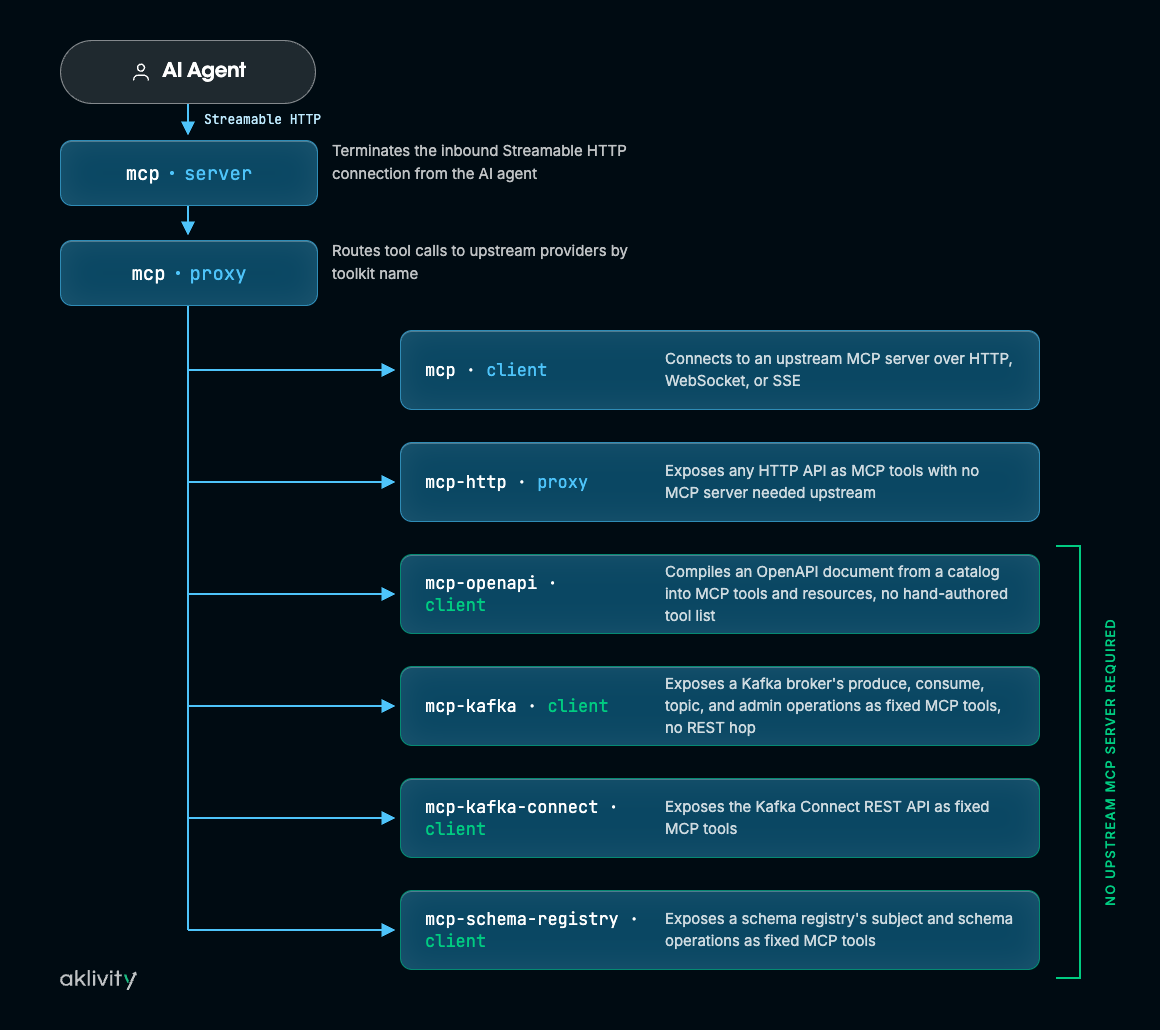
| Binding | Role |
|---|---|
mcp · server | Terminates the inbound Streamable HTTP connection from the AI agent |
mcp · proxy | Routes tool calls to upstream providers by toolkit name |
mcp · client | Connects to an upstream MCP server over HTTP, WebSocket, or SSE |
mcp-http · proxy | Exposes any HTTP API as MCP tools with no MCP server needed upstream |
mcp-openapi · client | Compiles an OpenAPI document from a catalog into MCP tools and resources, no hand-authored tool list |
mcp-kafka · client | Exposes a Kafka broker's produce, consume, topic, and admin operations as fixed MCP tools, no REST hop |
mcp-kafka-connect · client | Exposes the Kafka Connect REST API as fixed MCP tools |
mcp-schema-registry · client | Exposes a schema registry's subject and schema operations as fixed MCP tools |
The last four bindings need no upstream MCP server at all, either compiling one from an existing spec (mcp-openapi) or exposing a fixed, built-in tool set directly against the backend (mcp-kafka, mcp-kafka-connect, mcp-schema-registry). See Backend Bindings for when to reach for each one, or How It Works for how a request flows through the binding pipeline end to end.
Editions
| Component | Community | Plus |
|---|---|---|
| Inbound auth (JWT Bearer) | ✓ | — |
Outbound auth (oauth guard: Client Credentials, Token Exchange) | — | ✓ |
| Auth / listing cache store | Memory | Redis / Hazelcast |
Get Started
zilla.yaml
stores:
  cache:
    type: memory

bindings:
  north_tcp_server:
    type: tcp
    kind: server
    options:
      host: 0.0.0.0
      port: 7114
    routes:
      - when:
          - port: 7114
        exit: north_http_server

  north_http_server:
    type: http
    kind: server
    options:
      access-control:
        policy: cross-origin
    routes:
      - when:
          - headers:
              ":path": /mcp
        exit: north_mcp_server

  north_mcp_server:
    type: mcp
    kind: server
    exit: north_mcp_proxy
    telemetry:
      metrics:
        - mcp.*
      attributes:
        method: ${mcp.method}
        tool: ${mcp.tool}
        outcome: ${mcp.outcome}

  north_mcp_proxy:
    type: mcp
    kind: proxy
    options:
      cache:
        store: cache
        ttl: PT5M
    routes:
      - exit: bluesky_mcp_client
        when:
          - toolkit: bluesky
      - exit: payments_mcp_client
        when:
          - toolkit: payments

  bluesky_mcp_client:
    type: mcp
    kind: client
    options:
      server: http://bluesky-mcp:3001/mcp
    exit: sys:http_client

  payments_mcp_client:
    type: mcp
    kind: client
    options:
      server: http://payments-mcp:3002/mcp
    exit: sys:http_client

telemetry:
  metrics:
    - mcp.initialize
    - mcp.initialize.duration
    - mcp.tools.list
    - mcp.tools.list.duration
    - mcp.tools.call
    - mcp.tools.call.duration
  exporters:
    prometheus_exporter:
      type: prometheus
      options:
        endpoints:
          - scheme: http
            port: 7190
            path: /metrics
Try the example
The mcp.proxy example runs a full working MCP gateway with two upstream servers, toolkit routing, a 5-minute listing cache, and Prometheus metrics — all from a single docker compose up.